t
Showing posts with label Game Industry. Show all posts

Tuesday, April 14, 2015

Will You finding A Job in Game Industry?

The first job influences one's whole career since most of us would think and act in a way applied in the first job, thus we advise you choosing the first job cautiously. 

Some job, at the very start, may satisfy you in material but it won't be long to find the job is boring then start to look for another one. Every job would conclude in this way if you never realized what's the most important for choosing a job.  

You'd better do the job with strong interest and passion even though you may receive small salary at the beginning.  After all, working with interest and passion can make you fulfilled and happy, giving yourself a high quality life which can't be given merely by money. 

Well, which industry will you employ yourself in? How about game industry?

If you are definitely a gamer and always perform well, finding a job in game industry can yet be regarded as a nice choice. If you are at the same time, have one or two auxiliary skills like article writing and ps, I don't think game companies have reasons to reject you outside the door. 

Once you were involved in , you could always get access to  the new games at the first time, as well as chat with fellow players, write game reviews and make attractive game videos etc. You can get not only rich rewards but spiritual fulfillment. 

Every coin has two sides. You may get high paid but overwork will be an ordinary thing because game industry compete more fiercer than others. You may have no time exercising or getting together with your family, you may also suffer serious ache in your shoulder or back for sitting so long a time before computer.  

You can't have your cake and eat it too. Nothing is perfect but working on gaming can be a good choice comparatively. Will you finding a job in game industry? As for me, I have made choice. I am a gamer of online browser game as well as a marketing consultant for five years. The above is thought and inspirations is just from my real experience.

Ok, I need to take a rest now. Play Siegelord with me: siegelord.37.com

Saturday, April 11, 2015

Seven Strategies To Promote Online Games?

Let's come to the main topic directly. 

First, Be confident in your games.  You need to first fall in love with your own games and dig out what the spotlights of your games are. Besides, why people want to play games? You need to stimulate their motivation to play game. As the previous research shows, playing game have multiple benefits. Check the Six Benefits of Playing Online Games and Why the Man like Playing Games?

Second, Set periodical objectives. 
You need to ask yourself what you need to acquire before, during and after the game was launched. No details set then results can't be measured so please write down all the objectives in details.  

Generally speaking, before the game launched, you have to make your game known to all and encourage the public willingness to play. For example, you can use pre-register numbers to weigh the results. When the game was officially released, you need to build strong community to maintain the players. The FB page likes, blog subscribers and article views and discussions or something like these should be your objectives at this stage. What the objective need to be after the game launched several weeks. Now, you need to weigh the recharge, retention and the active reach. 

Keeping clear objectives in mind helps you always stand in the right track when take actions. 

Third, Subscribe game news. 
As a marketing person, you need to keep yourself informed of the gaming industry dynamics. It is a indication of professional quality. Google Alert is highly recommended. You need just  to set the keywords you want to track and set the email delivery frequency. 

Fourth, Learn some necessary skills.
Pictures and video are preferred nowadays than pure words. Sometime you need to record the gameplay as well as making pictures to fit your article. Using the right tools will twice the result with half effort. I recommend Camstudio for recording the gameplay and Gifcam for making the gif. pictures. To make the static picture, photoshop is always the best for me. 

Fifth, Create content for your games. 
Knowing the content marketing strategy and made content for your games. 

The marketing trend in 2015
You are not a qualified marketing person if you are still unknown about content marketing in 2015. Click the 100 content marketing examples for a reference. Some of the examples are not useful today, you need to filter the proper information for yourself when you going through the article. 

Sixth, making the most use of social media. 
Social media is just second to paid search ads nowadays. 


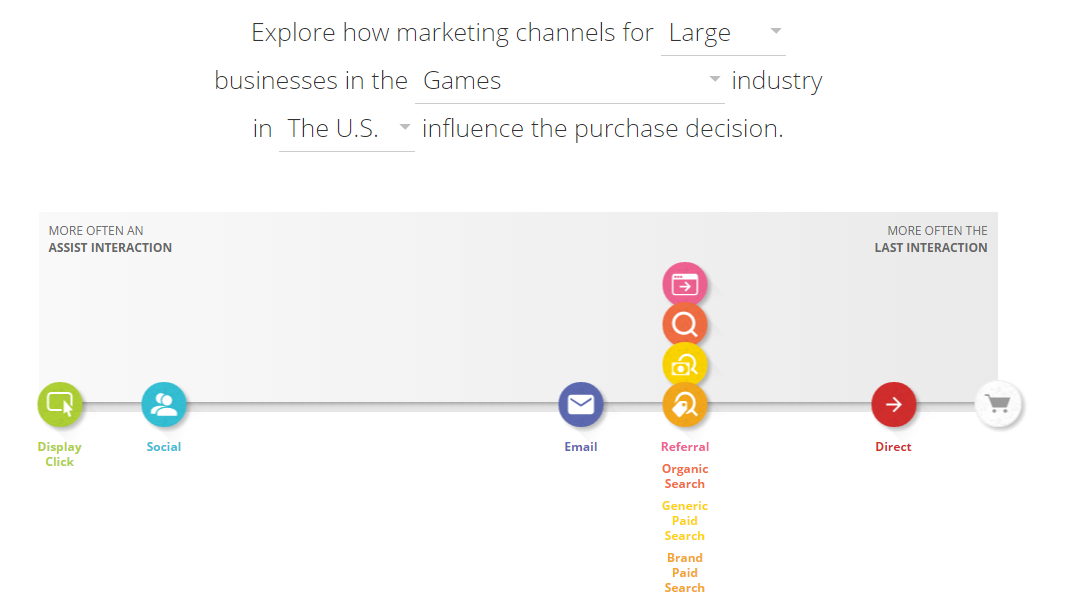
The funnel is the image of where your users are, if they are at the top they are far away from conversion, if they are at the bottom they are close to conversion.

And so companies try to convince users to convert through social media websites. It talks about their position in the funnel. Among all the social media, which one bears the strongest exposure ability? From the picture above, it's twitter,of course. You may also want to know how to maintain twitter account, just click here for the 27 tactics for promoting through twitter


Seventh, knowing what you should do in each stage. 
Look back to the second point, you have set your periodical goals. Now, what you need to do is to achieve all the goals. 

https://www.thinkwithgoogle.com/tools/customer-journey-to-online-purchase.html#!/the-us/games/large/email
At the earlier stage- To drive as more as social  and displaying ads traffics. 
At the middle stage- a. Design and deliver useful content to your registered players. b. Write game  updates or strategy to forums, article center, press release websites, etc. so as to seize as more as referral traffics. C. Buy keywords ads like adwords to list your game information frequently. 
At a later stage- All the above ways can be used together to impress your audience the most. Then the direct traffic will come continuously. 

The last is not a strategy but a recommendation for you to learn everything related to games. 
Just click here: http://www.pixelprospector.com/.We should always bear in mind that nothing remain unchanged, keep learning is the best way to make yourself be brilliant. 

What you may do after you went through the whole passage? How about playing Siegelord for a relax? Read the fair review of Siegelord now. 


Thursday, March 5, 2015

37Games Day Welfare Comes to All the 37 Players

First, let me explain how does 37Games Day come into being. 37Games sponsored the China International Game Conference abbreviated from CIGC which represents one of the top conference in the gaming industry held every March, 7th.  The special sponsor and the special conference date then made each March, 7th the 37Games Day.

Ok, on the special day every year you will receive a set of welfare by just sparing a little of your effort. The little effort you need to spare this year is to subscribe 37Games youtube channel

37Games Day- subscribe 37Games youtube channel

If the subscribers reaches 3,700 then 37 players of each game will receive the welfare. 
If the subscribers reaches 37,000 then all the 37Games registered players will receive the welfare. 

The welfare packs are as follows:

1. Rewards for 37 Players:

Dragon Atlas: 1M Gold, Lv4 Gem box x1
Siegelord: 370 Diamond
Chibi Warriors: Pet Pill x3, Godly Warrior’s Shard x3, Super Warrior Soul Pack x7.
ShiFu: 30M Silver, 20 Diamond, Source of HP x1, Source of MP x1

2. Rewards for all players:

Dragon Atlas:500,000 Gold
Siegelord: 37k Gold, 37k Food, 37k Timber, 37 Recruiting Horn.
Chibi Warriors: Pet Pill x3, Godly Warrior’s Shard x7, Super Warrior Soul Pack x7
ShiFu: 10M Silver

Wednesday, March 4, 2015

What is CIGC

CIGC, the China International Game Conference sponsored by 37Games was initially held in Shanghai in Mar.7, 2014. It's the annual feast among the gaming industry and will be held once a year on March 7. It is also called "37games Day".

The second conference was confirmed to be held in Zhu Hai, China, focusing on the development and operation on browser and mobile game, IP Resource, New ideas for game marketing and the global market extending. This conference will center on "How to forge browser games of high quality", "How to make the mobile games steadily step into an era of serious games" and " how to create more value through the Cross-boundary business". 
            CIGC-China International Game Conference

Zhu hai Chang Long Heng Qinwan Hotel

It was reported that one of the most popular and influential actress Liu Shishi will present on this conference, bringing it with more vitality. Taking this opportunity, many IP Game from 37Games  will  be published by Miss Liu together with 37Games president Li Yifei.  

It's worth mentioning that some games of excellent IP have achieved success globally while both browser and mobile games still face the grim challenge from game developer, operator and players worldwide. By putting ourselves in the game industry, we have to see further than others.  

Learn more about CIGC here: http://cigc.37.com/

Tuesday, March 3, 2015

Reports at GDC-Gain Control Over an Increasingly Depressing Work Environment

Reports at GDC-Gain Control Over an Increasingly Depressing Work Environment
What's been going on with the gaming community? Raph Koster, Gordon Walton and Rich Vogel are veterans of the online gaming space, and know a thing or two about how groups form and behave on the internet. At GDC, the three presented important findings for community managers about how to gain control over an increasingly depressing work environment.  
We now live in an age where the internet filters results for you based on assumptions about what you're like drawn from geographic location or other patterns. This creates a phenomenon called a "filter bubble," says Koster, where increasingly one's perception of the world is led by online targeting. Your average online user will increasingly see only those news sources and even political candidates that agree with their own views -- and anyone who's ever Facebook-blocked a relative with offensive political views has become complicit in this sort of filtering. 
In this climate, says Koster, the common context shared by disparate groups begins to erode, and homogenous groups crystallize. "As noble as we wish we are, we're not -- given the choice, people hang out with people like them," says Koster. 
"Given a limited population, over time, not only will we [form] groups that are like us, but the larger group will exterminate the other one," he says. "In simulations, that's what happens: They literally commit genocide, they literally chase everyone else out of the room. It's a distasteful fact about human nature, and if our definition about who we are is rigid, then you're going to have that conflict." 
People tend to make assumptions about behavior based on character, when in fact behavior is contextual and based on complex and deeply-felt beliefs. The theory goes that people are most likely to treat another person well when they feel they will see that person again. Trust is established through repeated interactions.
"This is how the world works, and some of this is uncomfortable. We doing community management have to deal with that, and part of the problem is that a lot of this has changed out from under the best practices we talked about 14 years ago," Koster says. "A lot of the things we take for granted as best practices just don't work anymore." 
For example, look at what free to play systems have done to the idea of persistent identity in games -- it's rooted in pulling in as many accounts as possible and churning through those that won't turn into paying users, and each time you log in you're part of a different group, with no attachment to your online identity or that of others.
"Without friction of some type, you end up in a place where it's difficult to create a peaceful community," says Walton. 
"You can do anything you pretty much want, and that's a problem for communities in free-to-play," adds Vogel.

The disappearing best practices

Our previous ideas about managing online communities or players were rooted in that persistence, the barrier to entry for account creation and maintenance, and systems of reputation and reward for good practices. Those elements are the "good fences that make good neighbors," as the saying goes. If players don't need to be invested in what others think of them, they're less likely to do their part to keep a community healthy. 
"In the real world, if you want to be a criminal you go to a big city, not in a town of sixty people," Walton adds. That's why large communities where users are most often anonymous tend to have the biggest culture problems. "What we've seen from the beginning is that scale matters. Everything we're talking about is fundamental human behavior." 
Without clear lines and well-bounded communities, people can become confused in a way that leads to conflict. For example, with Kickstarter and Early Access games, users become hostile and controversies arise because the distinction between a "customer" and a "funder", a creator and a user, is indistinct; confusion about different types of roles and relationships within the game industry gave rise to last year's "controversy that shall not be named." 
When you look at modern communities, from Twitter and Reddit to Facebook and chan boards, all the best practices -- keeping identity persistent, having a meaningful barrier to entry, specific roles, groups well-bordered and full anonymity at least somewhat difficult -- have been thrown out the window, giving rise to toxicity online, the veterans say. 
Facebook has held steadfast against user demand for a "dislike" button, and Koster says this is actually a wise move: The ability to downvote can destroy communities, he believes. Heavily-censured often abandon accounts and start again without consequences or responsibility, and in bigger cases, as with Reddit's brigading wars, people band together to destroy communities they dislike, downvoting them into oblivion. 
Mobbing behavior is also an issue online, from online harassment to call-out culture. Mobbing tends to single out those who are different, and working in fields with ambiguous standards increases one's risk of being mobbed. Of course, one person's harassment is another person's activism, and when people band together in opposition to negative behavior, it can be a positive experience for some. 
But for community managers, especially in games, mobbing is nearly always a bad sign, Koster warns: "It means you have a civil war on your hands, with heavy-duty consequences. Mobbing hurts a lot: Depression, sleep loss, weight loss, drug abuse, panic attacks... the thing to understand is how serious this can be for a victim," Koster says. "Think about the developers you work with and your own job, and this is part of why the churn rate for community managers is ridiculous. And what happens to your community if you allow this kind of thing to happen?"

What you can do

Perhaps there are no firm solutions just yet. But some things definitely work: Subdividing communities into manageable sizes and subcommunities -- no more than 150 regular commenters per forum, for example. Within subcommunities, minimize the reasons for different groups to be at odds, and offer "good fences" -- proper interfaces among communities, and meta-communities that serve to connect smaller communities. Offering a "honeypot," such as a single "general discussion" space that's allowed to be a nest of bad behavior, helps keep conflict-seeking users entertained and away from the others. 
Work around, not against anonymity -- a "pseudonymity" with private reporting channels and persistent logins is preferable. Incentivize positive contributions through some kind of reward or reputation system. 
Encouraging downvoting, brigading or other negative feedback loops is a design mistake, the veterans warn. So is driving intentional tribalism -- you want communities to feel strong and proud, but avoid offering ways to create competition within the userbase itself. Instead, emphasize ecological thinking. Failing to provide identity structures that offer common ground among groups is also a "don't." 
While it may be difficult, put yourself in the other's shoes. "This is hard, but I think community managers in particular need to investigate the cultures of all the different constituencies that are coming into their game," advises Koster. "Because for better or for worse, you are the translators that need to speak all the languages, and tell them what is okay there."
"Softening language" can be helpful -- phrases like I'm afraid or in my opinion. Speak positively to frustrated people -- "we prefer this type of behavior" is a better tactic to reduce problems than "you're doing something wrong." 
Use "I" and "we" statements instead of "you" in general. Find ways to show the other person that you are truly listening to their point of view, like repeating their arguments back or saying "I hear you." 
Be firm: "You're in our house and there are rules." This is a way of firmly dealing with users who are acting out, without having to field their accusations of tone-policing. Be sure to have the rules clear and visibly posted -- and be careful that moderating a user won't unecessarily upset too many others and make a situation worse. 
And finally, take precautions to protect your own personal information as a matter of self protection: Unlist your numbers, get domain name WHOIS protection, disable your phone's geolocation features, and request removal from databases. This will ensure you're safe if things go wrong and you become a target. 
"I don't believe there's such a thing as a private social media presence anymore," Koster says. 
"Everything we do gets picked up by the press now, and they consider it PR," adds Vogel. "So there's a real balance about how you manage that internally, and getting approval for what you say on the forums. The time that takes is going to be a hurdle. You're a community now, not making single-product games, and it's a big learning curve for publishers." 
"I know this seems like a bummer in the end, and maybe these solutions aren't enough. We live in a rapidly-changing world, and I hope people [like Facebook and Twitter] realize things need to change, that these things have been mis-designed and encourage poor behavior," says Koster. "If you do end up on the pointy end of a mobbing, most of this is not going to be helpful enough. The best advice I have is to disconnect completely, and take care of yourself first. The battle will be there another day." 
source: http://www.gamasutra.com/view/news/237808/Online_community_and_culture_wars_What_do_we_know.php
For more gaming industry news, please pay close attention to blog on Free to Play browser game news: http://gameonwebs.blogspot.com

Wednesday, February 4, 2015

Refined Operation-The Key to Generate Profit for 37Games

The Co-founder Zeng Kaitian for 37Games is Giving Speech at APGS 2015
The Co-founder Zeng Kaitian of 37Games is Giving Speech at APGS 2015 

At the end of last month, the APGS(Asia Pacific Game Summit)2015 was opened and the co-founder of 37Games Zeng Kaitian was invited to share his experience. Mr. Zeng emphasized mainly two points, namely IP strategy and refined operation. 
Intellectual Property is Rather Important for Games

Mr. Zeng pointed out that utilizing IP rights for games gives publishers a powerful catalyst to gain the initial user base that is crucial to the game’s success.I
t is easier to ride the name recognition and branding associated with the intellectual property. By indicating that the excellent IP is the catalyst of creating a successful game, Mr. Zeng also proposed fans of the originals would be probably converted to the fans of games at the beginning of promoting an IP Product. At the later stages, the high value of the originals would also generate strong power to push the game going further. 

Refined Operation is the Key to Generate Profit

It's far from being enough for having acquired excellent IP. The core element of attracting players to consistently play games is the quality. If lacking in novel and unique points, players won't be interested in the monotonous games, accordingly, the IP value will lost. To keep the IP value, 37Games have to operate their game subtly. Except the traditional online promoting, 37Games also started in the off-line promoting ways. For example, spending much in inviting popularity to publicize the games and placing ads into tv series and news. 37Games will try every way contributed to acquiring the public praise and  building brands. 

Localization - Thriving in Niche Markets

By the end of 2014, 37Games had entered the markets of South Korea, Thailand, Vietnam, Taiwan, North America, France and Turkey. O
ver 3,000 servers has been opened in all the markets and 37Games now has a use base exceeding 30,000,000 players.

Mr. Zeng also pointed out that sourcing translations may lead discrepancies in linguistic style. By bringing foreign talent in-house, he added, 37Games is able to better absorb and understand foreign player’s cultural preferences, payment habitsas well as their overall attitudes towards gaming. Zeng Kaitian also revealed that future English titles would also be fully localized by an in-house team as well. Keeping all of the localization work in-house is to keep the game and language styles flowing coherently. 

Want to learn more about what  games 37Games published here: http://www.37.com
Related Posts Plugin for WordPress, Blogger...